
The United States’ long history relating to chemical warfare stretches back to before World War I. Once chemical warfare was a battlefield reality, to protect our Military Forces on the battlefield and to ensure they had the capabilities needed to defeat our nation’s adversaries, the United States constructed several research and development facilities, chemical and filling plants, proving grounds, and chemical training areas.
Today, the United States, a signatory to the Chemical Weapons Conventions, and in Jully 2023, completed destruction of the last of its chemical munitions stockpile. As such, the United States no longer maintains an offensive chemical warfare capability.
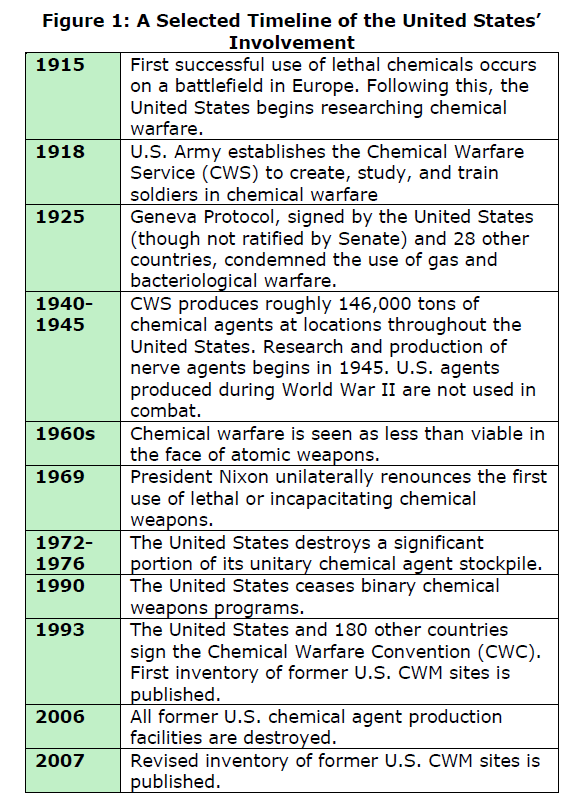
The Department of War (DoW) has already cleaned up several former chemical facilities and training areas located in the United States and continues to do so today. Some of the major events relating to the involvement of the United States in chemical warfare are presented in Figure 1.
Prior to World War I
International efforts to prevent the use of poisonous (toxic) chemicals in land warfare began in the 19th century. The first attempt at an international agreement limiting the use of such weapons was the 1874 International Declaration Concerning the Laws and Customs of War, which included in Article 13(a), a prohibition against poison or poisoned arms.
The next attempt was the Hague Convention of 1899. That convention contained the Declaration on the Use of Projectiles the Object of Which is the Diffusion of Asphyxiating or Deleterious Gases, which sought to prohibit the “… use of projectiles the object of which is the diffusion of asphyxiating or deleterious gases.” In all, 27 nations, including Austria-Hungary, France, Germany, Great Britain, and Russia, eventually agreed to this provision.
In the 20th century, Article 23 of the 1907 Hague Convention on Land Warfare explicitly prohibited the use of “poison or poisoned weapons” in warfare.
World War I (1914-1918)
Despite these international efforts, World War I saw the first large-scale use of toxic chemical weapons in land warfare.
French (August 1914) and German (October 1914) forces first used limited quantities of the tear gases ethyl bromoacetate and chloroacetone, against entrenched troops. The concentrations achieved in the field were reportedly so small that the use of the chemicals went largely unnoticed.
The Battle of Bolimóv on January 31, 1915, saw the first large-scale use of tear gas, when German forces fired some 18,000 shells containing liquid xylyl bromide tear gas at Russian positions. Although the chemical could be highly irritating, its use in battle proved ineffective.
The Second Battle of Ypres, Belgium on April 22, 1915, saw the first successful large-scale use of lethal chemical weapons, when the Imperial German Army released 188 tons of bertholite (chlorine gas) against French and Canadian forces, causing 6,000-7,000 casualties.
After the use of chlorine gas at Ypres, the U.S. Army began studying chemical warfare. Initial research took place at the American University Experiment Station near Washington, District of Columbia (D.C.). Today this location is the Spring Valley Site and is being remediated under the Formerly Used Defense Sites (FUDS) Program, part of the larger Defense Environmental Restoration Program (DERP).
Determining that chemical warfare was a significant threat to U.S. forces and an offensive weapon that could not be discounted, the Army Ordnance Department assigned chemical defensive methods and chemical weapons production to the Army Chemical Warfare Service (CWS). Established June 28, 1918, the CWS had seven main divisions:
- Research, responsible for identification of chemical agents in Washington, D.C.
- Gas Defense, responsible for production of gas masks in Long Island City, New York.
- Gas Offense, responsible for chemical agents and weapons production at Edgewood Arsenal, Maryland.
- Development, responsible for charcoal production and pilot-plant work on mustard agent production.
- Proving Ground, which was co-located with Training at Lakehurst, New Jersey.
- Medical, responsible for the pharmacological aspects of chemical defense.
Production
Nearly two years passed between the first use of toxic gas at Ypres and the declaration of war by the United States. The United States faced major challenges in establishing large-scale production facilities for chemical agents, chemical-filled shells, and the machinery for filling the shells. In February 1917, the U.S. Bureau of Mines offered assistance to the War Department (predecessor to DoW). One area studied by U.S. Bureau of Mines involved development of large-scale methods for the manufacturing of chloropicrin (PS) and phosgene (CG). In 1917-1918, the CWS built large-scale production plants at Edgewood Arsenal, Maryland (later the Edgewood Area, Aberdeen Proving Ground) and at several contractor-owned facilities.
At Edgewood Arsenal, three plants produced chlorine, PS, mustard (H), and CG. There were also three shell-filling plants. The first filled 75-millimeter (mm), 155-mm, 4.7-inch, and Livens projectiles with CG. A second plant filled 155-mm projectiles with H or PS. Two planned shell-filling plants were not completed before the end of the war.
Edgewood Arsenal produced more than 935 tons of CG and 711 tons of H by 1918. Government contractors also produced chlorine (CL), lewisite (L), H, and a mixture of PS and CG (PG). Total U.S. toxic chemical agent production in World War I was about 2,500 tons. L was in transit to Europe on November 11, 1918 (the date the Armistice went into effect), and was disposed of in the Atlantic Ocean. Figure 2 shows some of the chemical agent production facilities during World War I.

Delivery Systems
During the war, the Army used foreign-made offensive chemical weapons and delivery systems. American forces fired both British and French chemical rounds from 75-mm, 4.7-inch, 155-mm, and larger-caliber guns; most were French shells filled with CG and H, and British shells filled with H and L.
Use
Despite the production, during World War I, the U.S. did not employ any domestically produced chemical agents or weapons in combat.
Inter-War Years (1919 to 1939)
After 1919, all CWS Divisions except Headquarters moved to Edgewood Arsenal, which continued research and development, stockpiling of chemical agents and munitions, and training. Chemical agents and munitions unused during World War I became the basis of the Army’s stockpile.
On July 1, 1920, the CWS became a permanent part of the Regular Army, and began to standardize chemical agents, defensive measures, and the means of delivery.
Production
In 1928, the CWS selected seven chemical agents and smoke/obscurants for military use: H, methyldichloroarsine (MD), adamsite (DM), chloroacetophenone (CN), titanium tetrachloride (FM), white phosphorus (WP), and zinc oxide and hexachloroethane (HC). CL, PS, L, and CG and were of lesser importance.
In 1937, Edgewood Arsenal rehabilitated the World War I mustard agent production line and produced an additional 154 tons of H. Concurrently; the CWS upgraded the Edgewood Arsenal CG plant and standardized CG as a primary chemical agent.
Delivery Systems

During the 1920s and 1930s, the CWS stockpiled Livens projectors as well as cylinders and Stokes mortars. In addition, the Army manufactured chemical agent-filled shells for 75-mm, 105-mm, and 155-mm artillery pieces.
In 1924, the United States. standardized the design of the Livens projector and the 4-inch Stokes chemical mortar. This standardization addressed the weapons systems including the projectiles and the delivery system used to fire them.
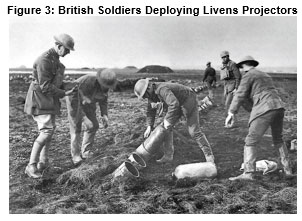
The Livens Projector is similar to a mortar. As shown in Figure 3, the projector was a metal tube, with the muzzle elevated to about 45 degrees and the breech embedded in the ground. The projector threw a canister of chemical agent or a can of petroleum intended to set fire to enemy emplacements. The range varied from 350 to more than 1,000 yards.
The 4-inch Stokes Chemical Mortar consisted of a smoothbore metal tube, a fixed base plate, and a lightweight bipod. Each shell held 6 to 9 pounds of PS, L, CG, the smoke/obscurant HC, or the tear gas CN.
In 1928, the United States introduced the model M1 4.2-inch Chemical Mortar. The M1 mortar projectiles could be filled with any one of a number of compounds including high explosive (HE) (trinitrotoluene [TNT]), a chemical agent (e.g., distilled mustard (HD) and smoke/obsurant (e.g., WP) variants.
Having seen the importance of aviation during World War I, the CWS developed the M1 30-pound chemical bomb. This bomb, never used in combat, held about 10 pounds of chemical agent. In 1933, the CWS developed the M10 Spray Tank. This tank held 320 pounds of H, 470 pounds of L, or smoke/obscurants. Likewise, the use of mine warfare led to development to the M1 Chemical Land Mine in 1939. This mine held nearly 10 pounds of H, and used detonating cord to burst the can and disseminate the agent.
Use
While work on new chemical agents and weapons continued across the globe, international efforts to outlaw the use of these weapons also continued. For example, the Limitation of Arms Conference, held in Washington, D.C., in 1922, proposed a ban on the use of poisonous gases except in retaliation. However, it was not ratified and was never implemented.
This unsuccessful attempt was followed in 1925 by the Protocol for the Prohibition of the Use in War of Asphyxiating, Poisonous or other Gases, and of Bacteriological Methods of Warfare, called the Geneva Protocol. This agreement, signed by 28 countries including the United States (but not ratified by the Senate) condemned the use of gas and bacteriological warfare.
During the inter-war years, the Army’s involvement with chemical agents and munitions was restricted to research, development, testing, evaluation and training.
World War II (1939 to 1945)
Production
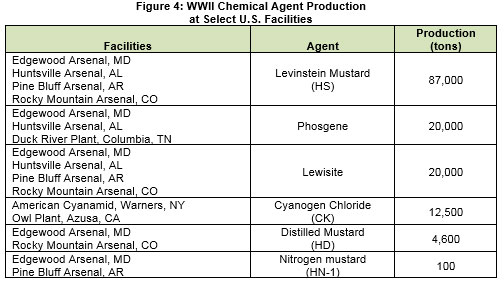
Partly a response to the war in Europe, 1940 and 1941 saw a major expansion of CWS infrastructure in the United States. The CWS built new arsenals in Huntsville, Alabama; Pine Bluff, Arkansas; and Denver, Colorado, and established the Dugway Proving Ground in western Utah. In addition to military facilities, the CWS set up many commercial suppliers, including, factories in Columbus, Ohio, Kansas City, Missouri, and New Cumberland, Pennsylvania, which made protective clothing; plants at Zanesville and Fostoria, Ohio, produced charcoal-filters; and impregnate (used to make clothing impermeable to chemical agents) factories were set up at East St. Louis, Illinois, Midland, Michigan, and Niagara Falls, New York.
Between 1940 and 1945, the CWS produced roughly 146,000 tons of chemical agents at locations throughout the United States. Figure 4 lists some of the chemical agent production facilities during World War II.
Delivery Systems
The expansion of chemical agent stockpiles included a corresponding increase in the number of delivery systems. The U.S. Army began the war with 44 4.2-inch chemical mortars. Demands for these versatile mortars grew rapidly as dedicated chemical mortar battalions were incorporated into the standard Army divisional structure. Concurrently, there were needs for improvements in accuracy, durability, ease in manufacturing, and maximum range. The first redesigned mortar, the M1A1, had a range of 3,200 yards. The next generation was the M2 4.2-inch mortar. During the war, the CWS procured more than 8,000 M2 chemical mortars for chemical mortar battalions. Although the mortar could fire H-filled shells, and more than 450,000 H-filled shells were produced, none were used in combat by U.S. forces.
Field Artillery units had 75-mm, 105-mm, and 155-mm shells filled with mustard agent or lewisite for the standard artillery cannon and howitzers of the time. For the Army Air Force, the CWS produced 100-pound mustard agent bombs; 500-pound CG or cyanogen chloride (CK) bombs; 1,000-pound CG, CK, or hydrocyanic acid (AC) bombs; and the M33 spray tank holding 750 to 1,120 pounds of H or L.
The CWS also developed detection capabilities: the M4 H Vapor Detector Kit, the M5 liquid detector paint, the M6 liquid detector paper, and the M7 detector crayon. The M9 Chemical Agent Detector Kit was a milestone. Produced in 1943, the M9 kit had a sampling pump, four bottles of reagents, and six clips of detector tubes. It could detect arsenicals (e.g., L), H, and CG, using simple color based tests.
Use
Drawing on the experience of World War I and the efforts in the inter-war years to institute international agreements prohibiting use of chemical weapons, early in the war, President Roosevelt established a no first-use policy for chemical weapons. The Axis nations wisely chose not to initiate wide-scale chemical warfare against the Allied powers. Thus, none of the U.S. chemical weapons were used on the battlefield during the war.
Post-war Years (1946 to 1960)
The end of World War II in 1945 triggered a massive demobilization of the U.S. Armed Forces. By early 1946, the CWS was demobilized to pre-war levels. The Army did continue some Technical Services, including the CWS, as part of the post-war Regular Army. One recognition of the need for a chemical warfare organization with the Army was Public Law 607, enacted on August 2, 1946, changing the name of the CWS to the U.S. Army Chemical Corps.
Production and Disposal
In the post-war period, the Chemical Corps concentrated on maintaining the existing stockpiles from World Wars I and II, and on producing new chemical agents (e.g., the organophosphate nerve agent – sarin [GB]), decontamination equipment, delivery systems, and detection systems. One of the first tasks undertaken was to find and evaluate the capabilities of the German and Japanese chemical warfare programs.
In the aftermath of the war in Europe, the Allies found the vast stockpile of German chemical weapons, some 296,100 tons. In response, the Continental Committee on Dumping agreed that America, Britain, France, and the Soviet Union would destroy the German chemical weapons in any convenient manner. The limited choices of the day were expending significant resources to build facilities specifically designed to destroy CWM; burial on land; open burning of the chemical agents and munitions; or sea disposal. The environmental understanding of the day, coupled with the desire to keep the CWM from potential enemies and to go home after six long years of war that encompassed the world, resulted in choosing sea-disposal as the most efficient and effective alternative.
Sea Disposal
In 1944, the War Department required CWM disposal occur in water at least 300 feet deep and 10 miles from shore. By December 1945, the Department increased the disposal depth requirement to 6,000 feet. The Department also published disposal locations in Notices to Mariners and on nautical charts. Thus, began a decade-long effort to dispose of excess, obsolete, unserviceable, and captured enemy munitions in the ocean and seas.
For example, Operation Davy Jones Locker, a joint American and British effort from 1946-1948, involved the sea disposal of 30,000-40,000 tons of captured German chemical weapons by scuttling 11 ships, nine in Skagerrak Strait connecting the Baltic and North Seas and two in the North Sea.
The U.S. Army also used sea disposal extensively for American chemical agents and munitions. This occurred by simply dropping loose munitions overboard. Later, the Army began mass sea disposals, such as about 5,000 tons of World War II lewisite-filled munitions and bulk containers disposed into the depths of the Atlantic Ocean about 160 miles off Charleston, South Carolina, in 1946 (DoD Sea Disposal Site NC-04).
Operation Geranium in 1948 saw the Army dispose of approximately 4,500 tons of lewisite in bulk containers into the Atlantic Ocean some 300 miles off the coast of Florida (DoD Sea Disposal Site FL-02). In all, about 13,250 tons of lewisite were disposed of at sea. The Army also disposed of about 11,000 tons of mustard and lewisite aboard the scuttled SS William C. Ralston in April 1958 (DoD Sea Disposal Site CA-10).
Chapter 10 of the Defense Environmental Programs Report to Congress Fiscal Year 2009 contains a detailed discussion of the sea-disposal of CWM by the United States in U.S. coastal waters.
Note: Actions to address sea-disposed CWM are outside the mission of the RCWM Program, unless recovery of a once sea-disposed CWM occurs on land inside the United States during an explosives or munitions emergency response. Section 314 of the Fiscal Year (FY) 2007 National Defense Authorization Act (NDAA), however, requested that DoD review archival information to verify the types, quantities, and locations of CWM and conventional munitions disposed in waters of the United States. The 2009 Defense Environmental Programs Annual Reports to Congress present the findings of this research.
A New Type of Chemical Agent
Another outcome of the Chemical Corps study of German CWM was the discovery of German organophosphate nerve agents. Invented in 1936 by a German chemical manufacturer, this new class of chemical agents disrupts the nervous system, leading to convulsions and eventual death. The CWS immediately shipped samples to facilities in the U.S. for further study. Between 1945 and 1947, more than 40,000 250-kilogram Tabun (GA) bombs, 21,000 mustard bombs of various sizes, 2,700 nitrogen mustard rockets, and about 750 Tabun artillery shells of various sizes were shipped to the U.S. from Europe. From this, the Chemical Corps developed and eventually produced both Tabun (GA) and GB, with GB adopted as a standard chemical agent by the United States.
Chemical Warfare’s Decline as a Viable Military Option (1960-1980)
With the advent of atomic and thermonuclear weapons, the U.S. military began shifting emphasis away from chemical weapons.
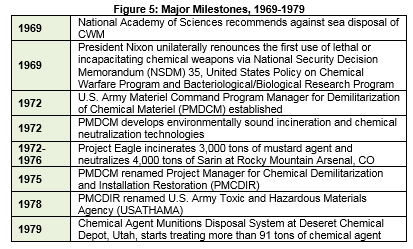
Although the Army maintained the Chemical Corps, and continued development of both defensive and offensive measures, the aging stockpile of artillery shells, bulk containers, and rockets began to require demilitarization and disposal. The options for disposal remained limited. In the 1960s, under Project EAGLE, the Army developed incineration and neutralization systems, and, in the 1970s, destroyed 3,000 tons of H and 4,000 tons of GB at Rocky Mountain Arsenal (RMA), Colorado.
In 1971, under Operation Red Hat, DoD removed all chemical munitions from Okinawa, Japan, to Johnston Atoll.
In 1971, the Army constructed the Chemical Agent Munitions Disposal System (CAMDS), a pilot incineration facility at Deseret Chemical Depot (DCD), Utah. Operations began in 1979 and ultimately, CAMDS safely destroyed 91 tons of chemical agent.
End of United States Development of Chemical Warfare (1980-Present)
In the early 1980s, the Army developed binary chemical weapons to modernize the aging chemical weapons stockpile. Designed to mix two non-lethal chemicals while in flight to a target to form chemical agent, binary chemical weapons development helped move the Soviet Union into arms reduction negotiation and the signing of a bilateral agreement in 1990. This agreement led to the CWC, an international treaty signed by more than 180 countries that mandates the elimination of chemical warfare materiel and former chemical weapons production facilities.
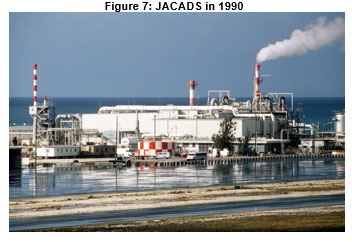
In 1985, the Army opened the Johnson Atoll Chemical Agent Disposal System (JACADS). In 1990, Operation Steel Box, a joint U.S.-West German operation, moved some 100,000 sarin and VX filled American chemical munitions from West Germany to Johnston Atoll for destruction. The first weapon disposal at JACADS took place on June 30, 1990. That day, JACADS became the first U.S. chemical weapons disposal facility. Figure 7 shows the JACADS facility in 1990.
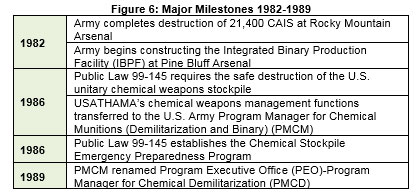
In 1986, Public Law 99-145 required the safe destruction of the U.S. unitary chemical weapons stockpile. It also required disposal facilities to be cleaned, dismantled, and disposed of according to applicable laws and regulations. The stockpile was stored at eight military installations within the continental United States – APG, Maryland, Pine Bluff Arsenal (PBA), Arkansas, DCD, Utah, Umatilla Chemical Depot (UMCD), Oregon, Newport Chemical Depot (NECD), Indiana, Anniston Army Depot (ANAD), Alabama, Blue Grass Army Depot (BGAD), Kentucky, and Pueblo Chemical Depot (PCD), Colorado – and on Johnston Atoll.
In 1992, in response to Public Law 102-484, the Army established the Non-Stockpile Chemical Materiel Project (NSCMP) to develop systems to safely assess, treat and destroy five categories of chemical warfare materiel not part of the declared stockpile:
- Binary chemical warfare materiel;
- Former chemical weapons production facilities;
- Miscellaneous chemical warfare materiel;
- Buried chemical warfare materiel; and
- Recovered chemical warfare materiel.
The last two categories eventually become the RCWM Program.
In 1993, the U.S., Russia, and other countries signed the CWC. The CWC:
- Prohibits production and use of chemical weapons.
- Requires destruction of chemical weapons production facilities and all chemical weapons (including chemical weapons abandoned outside each state party’s territory).
- Established the Organisation for the Prohibition of Chemical Weapons (OPCW).
- Set an OPCW inspection regime for the production of chemicals which might be converted to chemical weapons.
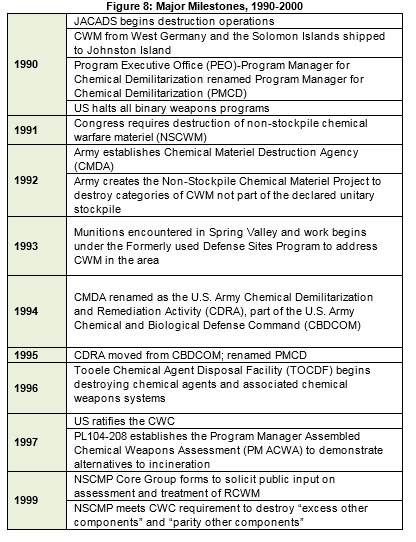
In 1997, the U.S. Senate ratified the CWC, subject to a series of specific limitations. Complete details on the U.S. ratification, the implementing statutes and regulations, and the requirements for reporting and verification are available at the United States Chemical Weapons Convention Website.
From 1990 to 2000, when JACADS destruction operations ceased, the United States destroyed more than 400,000 chemical rockets, projectiles, bombs, mortars, ton containers, and mines containing GB, H, and VX. This represented about four percent of the U.S. chemical agent stockpile. The JACADS facility was closed and decommissioned permanently in 2003.
In 2001, the NSCMP treated 10 sarin-filled bomblets recovered at RMA, Colorado, using the EDS for the first time. That same year, the United States met the CWC treaty requirement to destroy 20 percent of the U.S. chemical weapons stockpile.
In 2002, the NSCMP completed destruction of items in the CWC category “Miscellaneous Chemical Warfare Material.” This category included both treaty and non-treaty items, such as unfilled munitions, support equipment, and devices designed for use with chemical weapons. These included complete assembled rounds without chemical fill and with or without bursters and fuzes, simulant-filled munitions, inert munitions, dummy munitions, bursters and fuzes, empty rocket warheads and motors, projectile cases, other metal and plastic part components, research and development compounds, chemical samples and ton containers.
In 2006, destruction operations at the Edgewood Area of APG used neutralization to destroy 1,622 tons of mustard agent in ton-containers, thus eliminating more than five percent of the U.S. chemical agent inventory. This facility is closed and permanently decommissioned.
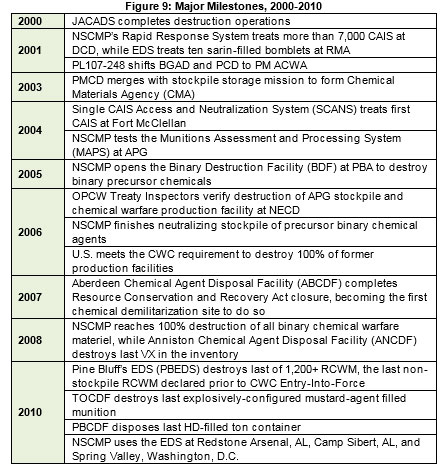
In 2006, the NSCMP:
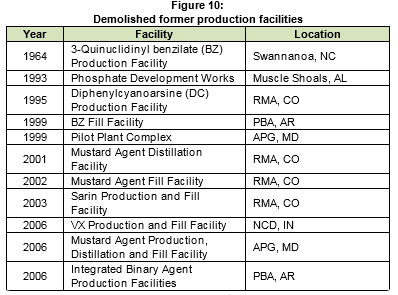
- Finished demolishing former chemical weapons production facilities, as required by the CWC. Figure 10 lists the facilities and the destruction dates;
- Completed destruction of the existing stores of binary agents methylphosphonic difluoride (DF) and diisopropyl aminoethylmethyl phosphonite (QL) at PBA, Arkansas;
- Demolished the final building used for destroying the binary chemicals;
- Saw CWC Treaty inspectors verify demolition of the final portion of the VX production process at NECD, and destruction of the APG mustard agent stockpile;
- Completed demolition of all Aberdeen Chemical Agent Disposal Facility (ABCDF) buildings not held for other uses; and
- Began operation of the Pine Bluff Explosive Destruction System (PBEDS), starting the treatment of more than 1,200 recovered munitions at PBA, Arkansas.
In 2008, destruction operations at NECD, Indiana, used neutralization to destroy VX in ton containers. This eliminated an additional four percent of the U.S. chemical agent inventory. The facility is permanently decommissioned, and the depot closed.
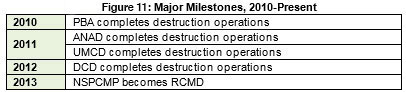
In 2010, the demilitarization facility at PBA, Arkansas, completed destruction of 90,409 M55 GB rockets, 19,608 M55 VX rockets, 9,378 M23 VX landmines and 3,705 mustard ton containers, representing about 12 percent of the U.S. chemical weapons stockpile. This facility is also closed, although the arsenal remains open. At PBA, NSCMP operated two EDS units under the PBEDS project to address numerous munitions recovered from demilitarization operations that took place in the 1940s. In 2010, the NSCMP and the operators at the PBEDS destroyed the last declared munitions at the installation.
In 2011, the demilitarization facility at ANAD, Alabama, completed destruction operations of various munitions and chemical agents, containing mustard agent, sarin, and VX, representing about seven percent of the U.S. chemical agent inventory. This facility is closed, although Anniston Army Depot (AAD) remains open performing other missions.
In addition, 2011 saw destruction operations completed at UMCD, Oregon. The chemical weapons stored at the depot consisted of various munitions and ton containers containing mustard agent, sarin, and VX stocks, representing of about 12 percent of the U.S. chemical agent inventory. This depot is closed.
In 2012, stockpile disposal operations using incineration were completed at DCD, Utah. The stockpile consisted of various munitions and ton containers containing mustard agent, lewisite, sarin, tabun, and VX, and represented elimination of about 44 percent of the U.S. chemical agent inventory. This facility is closed, and the depot was transferred back to Tooele Army Depot (TEAD), and is now known as TEAD-South.
Also in 2012, CMA was redesignated as the U.S. Army Chemical Materials Activity, a separate reporting activity under the U.S. Army Materiel Command (AMC), and the stockpile destruction portion of CMA and NSCMP were transferred to the newly formed Joint Project Manager for Elimination (JPME) under the Program Executive Office for Chemical and Biological Defense (PEOCBD). The NSCMP mission was returned to CMA in 2013, as the Recovered Chemical Materiel Directorate (RCMD).
While awaiting completion of a large-scale facility to eliminate chemical munitions at PCD, Colorado, RCMD provided an EDS to support the Program Executive Office for Assembled Chemical Weapons Alternatives (ACWA) in destroying munitions that cannot be processed in the main facility, the Pueblo Chemical Agent-Destruction Pilot Plant (PCAPP). The first campaign of the system known as the PCAPP EDS ran from March 2015 to February 2016 to destroy 560 overpacked munitions in storage. A second campaign to destroy reject CWM began in 2018 and destroyed 369 munitions before the EDS was demobilized from PCD in 2019. Operations at the main PCAAP plant began in 2016.
The most significant challenge remaining is locating and properly disposing of buried chemical agents, chemical agent identification sets (CAIS), chemical munitions, and munitions and certain materials of interest having an unknown fill. This is one aspect of the mission of the RCWM Program.